About the Project
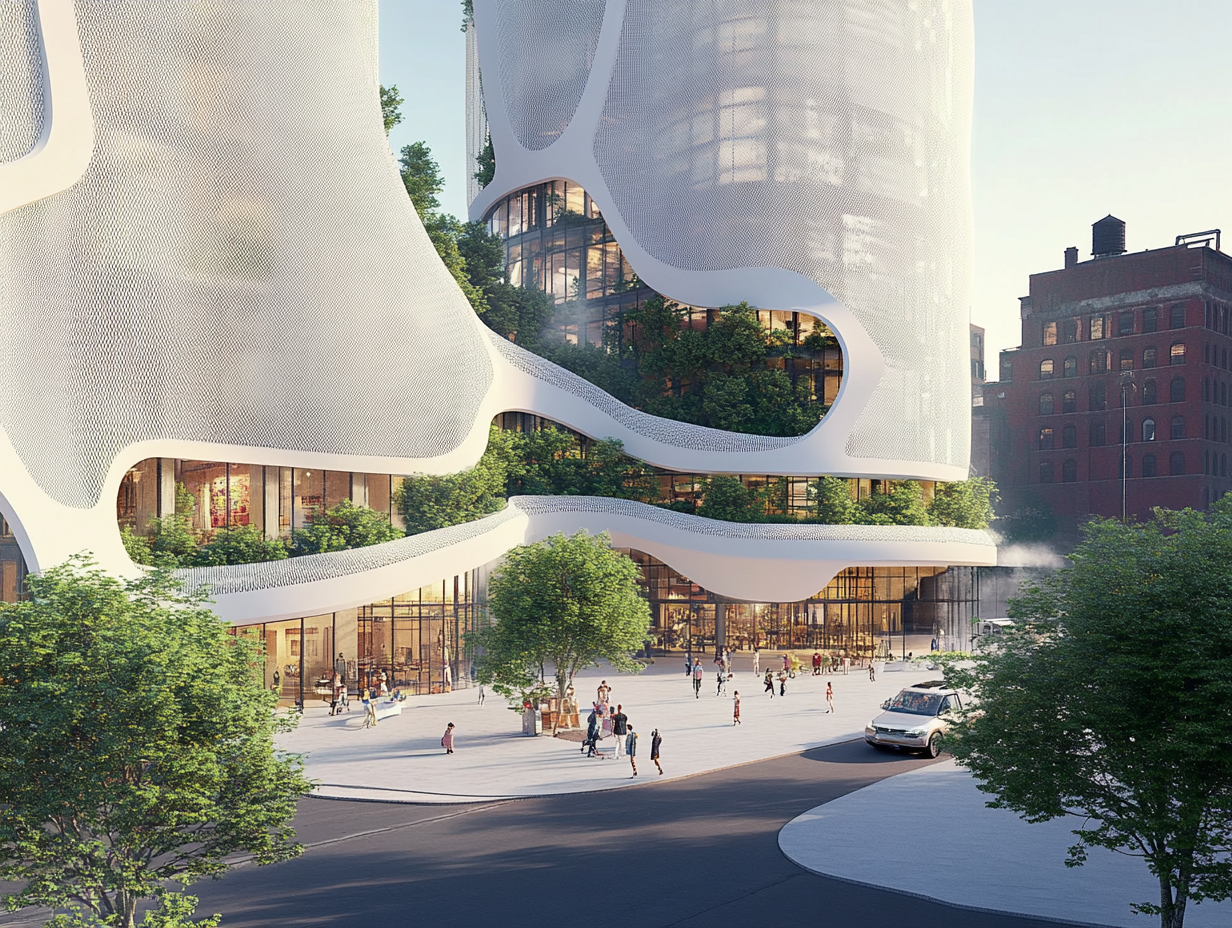
Rooted in the core concept of "historic reinterpretation and green synergy," this design adaptively reuses industrial remnants—preserving and transforming exposed steel trusses and soaring arched openings—while integrating two eco-residential towers clad in white lightweight materials and layered with organic curves. Vertical greenery and a breathable façade system promote urban sustainability, while the elevated ground level forms a vibrant public plaza and marketplace. Bathed in natural light, the architecture bridges past and future, shaping a contemporary urban seam where humanity, heritage, and nature coexist.
This project is rooted in the principle of adaptive reuse, transforming an obsolete industrial factory into a vibrant mixed-use community. It preserves the exposed steel trusses and monumental arched entrances of the original structure, emphasizing the site's historical fabric and urban memory. This approach aligns with the core values of adaptive reuse—repurposing existing architecture while honoring its heritage—extending the lifecycle of the built environment, minimizing demolition waste, and promoting ecological sustainability. Seamlessly integrated behind the preserved industrial skeleton are two eco-residential towers, sculpted with biomorphic curves and expressed in flowing spiral forms and staggered setbacks. Their design evokes nature’s inherent fluidity—“no straight lines, only free forms”—blurring the boundary between architecture and landscape. The façades are clad in pristine, lightweight composite materials: matte white aluminum panels and perforated metal mesh create a clean, modern geometry; translucent polycarbonate fins filter daylight during the day and glow softly at night; and tensile white membrane canopies crown the towers, adding layers of shadow and light while serving as weather protection. A monochromatic white palette unifies the visual identity, creating a stark yet harmonious contrast with the lush greenery. The towers feature vertically layered green façades, incorporating vegetation systems directly into the architectural envelope to form a vibrant vertical forest. Drawing on the concept of a “breathing façade,” a double-skin system incorporates planted interstitial layers between the inner floor enclosures and the outer fragmented white elements, resembling organic windbreaks. At varying heights, semi-outdoor sky gardens—“aerial forests”—are embedded to provide shared community spaces infused with greenery and natural ventilation. The façade incorporates adjustable white louvers and green ecological membranes, responding to solar orientation to modulate light and temperature, absorb airborne dust, and ensure comfort both indoors and out. Together, the architecture and vegetation form a dynamic environmental buffer that enhances energy performance and enriches the cityscape. Functionally and spatially, the ground plane of the building is elevated on slender pilotis, freeing up the base beneath the industrial skeleton to form a semi-open public space. This configuration references Le Corbusier’s modernist principle of “elevated structures on columns,” liberating ground-level space for communal uses. The resulting public plaza features floating white timber platforms, minimalist pergolas, local market stalls, outdoor cafés, children’s play zones, and diverse gathering areas that invite interaction among different users. Dedicated bike lanes ensure safe circulation, while roadside drop-off areas accommodate vehicular access. From within the plaza, the preserved steel framework and newly added towers remain visually legible: the towers’ recessed massing minimizes their visual dominance, respecting the historic silhouette and visual hierarchy of the site. The scene is set in the golden hour of dawn or dusk, where warm, slanting sunlight filters through canopy leaves and tensile membranes, casting gentle, kinetic shadows across white stone pavements and façades. As in high-quality architectural renderings, natural light and shadow interplay are key to achieving realism and atmosphere. The sunlight reveals the soft sheen of matte white panels, the subtle luminescence of polycarbonate fins, the delicate textures of perforated mesh, and the warm grain of timber decking. Deep green foliage stands in stark contrast under angled light, emphasizing the spatial layering and poetic material expression. Visually, the architecture is rendered in a photo-realistic cinematic style: the perspective aligns with human eye level to enhance immersion, while dynamic motion blur adds life to figures and vehicles in transit. Glass and metal surfaces reflect their surroundings with natural precision, and volumetric light beams penetrate the particulate air, creating halos that intensify depth and drama. This filmic lighting treatment amplifies the ethereal quality of the architecture while faithfully portraying scenes of contemporary urban life—families strolling, cyclists weaving through paths, vendors engaging with passersby, electric vehicles recharging, skateboarders in motion, and modern trams gliding into view—all coexisting in a vibrant, human-centered public realm.
AI Tools & Workflow
runway,promeai